Roman Shades vs. Traditional Curtain Panels: Which Structure Fits Your Window Best?

Apr 07 2026
Window treatments do far more than decorate a room. They influence lighting, privacy, insulation, mood, and even how large or balanced a space feels. Among the many options available today, two styles remain consistently popular in modern homes: Roman shades and traditional curtain panels.
At first glance, choosing between them may seem like a purely aesthetic decision. However, the structural differences between these two window coverings significantly affect functionality, installation, maintenance, and compatibility with different window types.
If you’ve ever wondered why Roman shades look perfect in one room but awkward in another—or why classic curtains sometimes overwhelm certain windows—this guide will help you understand exactly which structure works best for your space.
Let’s break down the differences in a practical, room-by-room way so you can choose confidently.
Understanding the Basics
Before comparing performance, it’s important to understand how each option is constructed.
What Are Roman Shades?
Roman shades are fabric window coverings that fold into horizontal pleats when raised and lie flat when lowered.
Instead of sliding sideways like curtains, Roman shades move vertically using a cord or motorized mechanism.
Structural Characteristics
- Mounted inside or above the window frame
- Fabric stacks neatly at the top
- Smooth, tailored appearance
- Minimal side coverage
Roman shades combine the softness of fabric with the clean geometry of blinds.
What Are Traditional Curtain Panels?
Traditional curtain panels—also called drapes—consist of fabric panels that hang vertically and open horizontally from the center or sides.
They are typically installed on rods mounted above the window.
Structural Characteristics
- Fabric gathers or pleats vertically
- Opens left and right
- Covers wall area beyond the window
- Often layered with sheers or liners
Curtains create depth, movement, and visual softness.
The Core Structural Difference
The most important distinction is direction of operation.
| Feature | Roman Shades | Curtain Panels |
|---|---|---|
| Movement | Vertical | Horizontal |
| Visual footprint | Compact | Expansive |
| Wall coverage | Minimal | Extended |
| Architectural impact | Structured | Flowing |
This directional difference determines which window types each style complements.
How Window Shape Influences Your Choice
Not all windows behave the same visually or functionally.
Choosing the right structure depends largely on window proportions.
Best Windows for Roman Shades
1. Small or Narrow Windows
Roman shades excel where space is limited.
Because they stay within the frame, they avoid overwhelming compact openings.
Ideal locations:
- Bathrooms
- Kitchens
- Hallway windows
- Office nooks
Curtains in these spaces can feel bulky.
2. Deep Window Frames
If your window has recessed framing, Roman shades create a custom-built appearance.
Inside mounting emphasizes architectural depth and precision.
3. Modern or Minimalist Interiors
Roman shades align with:
- Clean lines
- Neutral palettes
- Contemporary design
- Scandinavian aesthetics
Their flat surface reduces visual noise.
4. Windows Near Furniture
When furniture sits close to windows—like beds, desks, or sofas—curtain movement becomes restricted.
Roman shades eliminate side clearance issues.
Best Windows for Traditional Curtain Panels
1. Large Picture Windows
Curtains enhance scale and drama.
Wide panels visually frame expansive glass areas and balance proportions.
2. Floor-to-Ceiling Windows
Curtains emphasize vertical height, making ceilings appear taller.
This is one of the strongest advantages of drapery.
3. Sliding Doors and Patio Doors
Horizontal operation makes curtains easier for frequent access.
Roman shades would require constant lifting and lowering.
4. Classic or Transitional Interiors
Curtains complement:
- Traditional homes
- Farmhouse styles
- Transitional design
- Layered décor schemes
They introduce softness and texture.
Light Control Comparison
Lighting behavior differs dramatically between structures.
Roman Shades: Precision Control
Roman shades provide:
- Even light filtering
- Adjustable height positioning
- Minimal side gaps (inside mount)
They function similarly to blinds but look softer.
Best for:
- Workspaces
- Reading areas
- Kitchens
Curtain Panels: Atmospheric Lighting
Curtains diffuse light more organically.
Layering options include:
- Sheer inner panels
- Blackout outer panels
- Thermal liners
They allow flexible ambiance creation.
Privacy Performance
Privacy depends on coverage style.
Roman Shades
- Strong frontal privacy
- Slight side exposure depending on mount
- Excellent for street-facing windows
Curtains
- Full wall coverage possible
- Better side-angle blocking
- Ideal for bedrooms
Insulation and Energy Efficiency
Window treatments significantly influence indoor temperature.
Roman Shades and Insulation
When fitted closely, Roman shades trap air between fabric and glass.
Benefits:
- Reduced heat transfer
- Improved winter insulation
- Clean sealing effect
Honeycomb-lined Roman shades enhance this further.
Curtain Panels and Insulation
Heavy drapes create a thermal barrier across a wider area.
Advantages:
- Blocks drafts
- Reduces heat gain
- Improves acoustic absorption
Floor-length curtains often outperform shades in cold climates.
Maintenance and Cleaning Differences
Lifestyle plays a major role here.
Roman Shades Maintenance
Pros:
- Collect less dust
- Compact surface area
- Easy vacuum cleaning
Cons:
- Full washing may require professional cleaning
- Mechanisms need occasional adjustment
Curtain Maintenance
Pros:
- Removable panels
- Machine-wash options available
Cons:
- Larger fabric collects more dust
- Requires regular laundering
Homes with pets may need more frequent curtain cleaning.
Installation Complexity
Roman Shades
Installation requires precise measurement.
Inside mounting must be exact to function smoothly.
DIY difficulty: Moderate.
Curtain Panels
Curtains are more forgiving.
Rod placement allows flexibility even if measurements aren’t perfect.
DIY difficulty: Easy.
Visual Impact on Room Size
Window treatments can alter spatial perception.
Roman Shades
Create a tidy, uncluttered appearance.
Rooms feel:
- Organized
- Minimal
- Architecturally refined
Best for smaller rooms.
Curtain Panels
Add visual volume.
Rooms feel:
- Taller
- Softer
- More luxurious
Best for larger spaces.
Layering Possibilities
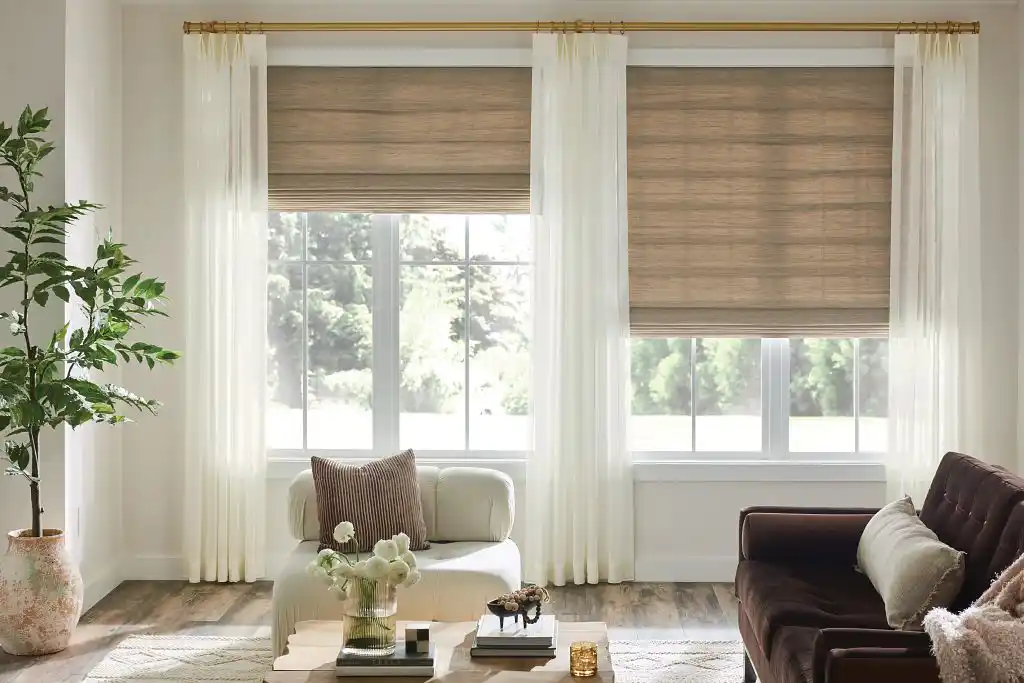
Modern interiors often combine both options.
Popular Combination
Roman shade + curtain panels.
Why it works:
- Shade provides functional control.
- Curtains add decorative framing.
This hybrid solution works especially well in living rooms and master bedrooms.
Room-by-Room Recommendations
Kitchen
Winner: Roman shades
Reasons:
- Space efficiency
- Easier cleaning
- Less exposure to grease and moisture
Living Room
Winner: Depends on scale
- Large windows → curtains
- Medium windows → combination setup
Bedroom
Winner: Curtain panels (or layered solution)
Better blackout capability and softness.
Bathroom
Winner: Roman shades
Compact and moisture-friendly when using synthetic fabrics.
Home Office
Winner: Roman shades
Precise light control reduces screen glare.
Style Versatility Comparison
Roman Shade Styles
- Flat fold
- Relaxed fold
- Balloon style
- Tailored pleats
Each changes the formality level.
Curtain Styles
- Pinch pleat
- Grommet
- Rod pocket
- Ripple fold
Curtains offer more stylistic variation overall.
Cost Considerations
Pricing depends on fabric and customization.
Roman Shades
Typically higher per window due to mechanisms.
Best suited for fewer, strategically chosen windows.
Curtain Panels
Often more economical for large areas.
Fabric quantity increases cost but hardware remains simple.
Common Mistakes When Choosing
Choosing Based Only on Appearance
Structure matters as much as style.
Ignoring Window Function
Frequently opened windows need easy operation.
Mounting Too Low
Curtains hung higher make ceilings appear taller.
Using Heavy Curtains in Small Rooms
Can overwhelm limited space.
How to Decide: A Simple Framework
Ask yourself:
- How large is the window?
- How often is it opened?
- Is space limited nearby?
- Do you want minimalism or softness?
- Is insulation a priority?
Your answers usually reveal the best choice quickly.
Future Trends in Window Treatments
Modern homes increasingly favor flexibility.
Growing trends include:
- Motorized Roman shades
- Layered window systems
- Neutral textured fabrics
- Energy-conscious materials
Rather than replacing curtains entirely, many homeowners now mix structured and soft treatments.
Frequently Asked Questions
Are Roman shades more modern than curtains?
Generally yes, but fabric choice determines overall style.
Can Roman shades work in large windows?
Yes, but multiple shades may be required.
Do curtains block more light?
Blackout curtains typically outperform standard shades unless shades include blackout lining.
Which lasts longer?
Both can last many years with proper care; mechanical components in shades may eventually need replacement.
Final Thoughts
Choosing between Roman shades and traditional curtain panels isn’t about which option is better overall—it’s about which structure works best for your specific window type, room function, and design goals.
Roman shades excel where precision, space efficiency, and architectural clarity matter most. Curtain panels shine when softness, scale, and dramatic framing enhance the room.
Understanding how each interacts with window shape, lighting needs, and daily use allows you to make a decision that feels intentional rather than decorative guesswork.
In many homes, the smartest solution isn’t choosing one over the other—but using each where it performs best.
When structure aligns with function, window treatments stop being accessories and start becoming integral parts of your home’s comfort and design experience.
Related Products