Say No to the “Expectation vs. Reality” Curtain Mistake: Why Floor-to-Ceiling Curtains Should Be 2.5× Wider Than Your Window

Mar 25 2026
Introduction: The Curtain Problem Nobody Talks About
You ordered beautiful curtains online. The fabric looked luxurious, the color matched your interior palette perfectly, and the photos promised a magazine-worthy living space. But once installed, something felt… wrong.
The curtains looked flat. Cheap. Awkwardly stretched. Instead of soft elegance, the room suddenly resembled a temporary rental or a staged showroom missing its finishing touches.
This common disappointment — often jokingly called the “expectation vs. reality” effect — rarely comes from poor fabric quality or bad color choices. The real problem is almost always incorrect curtain width.
Interior designers agree on a fundamental principle that many homeowners overlook:
Floor-to-ceiling curtains should typically measure about 2.5 times the width of the window.
This single rule transforms curtains from functional coverings into architectural elements. Understanding why requires looking beyond decoration and into proportion, light behavior, fabric physics, and visual psychology.
This article explores the science, design logic, and practical application behind the 2.5× curtain width rule — and explains why getting this measurement right instantly elevates any space.
Curtains Are Architecture, Not Accessories
Many people treat curtains as optional décor, similar to throw pillows or wall art. Professional designers, however, see curtains as soft architecture.
Curtains influence:
- Perceived ceiling height
- Window scale
- Light diffusion
- Room symmetry
- Acoustic softness
- Emotional atmosphere
Unlike small decorative items, curtains occupy large vertical surfaces. This makes them one of the most visually dominant elements in a room.
When proportions are incorrect, the entire space feels unbalanced — even if everything else is perfectly styled.
The Origin of the 2.5× Rule
The 2.5× width guideline didn’t appear randomly. It evolved from centuries of textile design and theater staging.
Historically, grand European interiors used heavy drapery to frame tall windows. Designers discovered that fabric requires sufficient excess material to create natural folds, also known as fullness.
Too little fabric produces tension and flatness. Too much creates bulk and heaviness.
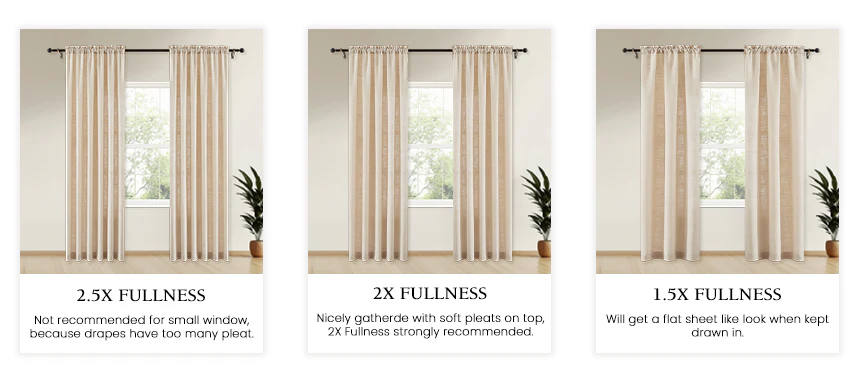
Through experimentation, designers found that fabric fullness between 2× and 3× window width produced the most visually pleasing results. Modern residential interiors settled on 2.5× as the ideal balance.
This ratio achieves:
- Deep, elegant pleats
- Smooth stacking when opened
- Balanced visual weight
- Consistent light filtering
It works across most fabrics and interior styles.
Understanding Fabric Fullness: The Secret Behind Luxury Curtains
The difference between budget-looking curtains and luxury drapery is rarely price — it’s fullness.
What Is Fullness?
Fullness refers to how much extra fabric exists beyond the window width.
Example:
- Window width: 80 inches
- Curtain width (2.5× rule): 200 inches total fabric
That additional material creates folds even when curtains are closed.
Why Folds Matter
Human perception associates softness and depth with comfort and quality. Flat surfaces feel temporary and utilitarian.
Folds create:
- Shadow variation
- Dimensional texture
- Visual rhythm
- Movement with airflow
These subtle cues signal craftsmanship and intentional design.
The Physics of Fabric Behavior
Curtains are dynamic objects influenced by gravity, tension, and light.
When fabric hangs vertically, gravity pulls it downward, forming curves. Without sufficient width, fabric cannot curve naturally — it stretches instead.
Insufficient width leads to:
- Diagonal tension lines
- Uneven pleats
- Visible hardware stress
- Poor light diffusion
At approximately 2.5× width, fabric gains enough slack to fall into consistent wave patterns.
These waves distribute weight evenly, allowing curtains to hang smoothly over time.
Light Diffusion: Why Width Changes How Sunlight Feels
Curtains don’t just block light — they shape it.
When sunlight passes through folded fabric, it scatters across multiple angles. Each fold acts like a miniature diffuser.
With proper fullness:
- Light becomes softer
- Glare decreases
- Shadows appear layered
- Rooms feel warmer
Flat curtains allow light to pass directly through, creating harsh brightness and uneven illumination.
This is why professionally designed spaces feel calm even when filled with natural light.
Visual Illusion and Spatial Psychology
Interior design relies heavily on perception.
The human brain interprets proportion subconsciously. Curtains wider than the window create an illusion that the window itself is larger.
This produces several psychological effects:
1. Expanded Space
Wide curtains visually stretch walls outward, making rooms feel larger.
2. Taller Ceilings
When curtains extend fully across a wall, vertical lines emphasize height.
3. Balanced Symmetry
Extra width prevents curtains from appearing squeezed or undersized.
Essentially, curtains become framing devices for architecture.
Why Narrow Curtains Always Look Cheap
Even expensive fabrics look inexpensive when too narrow.
Common visual problems include:
- Curtains barely covering glass edges
- Visible gaps when closed
- Flat panel appearance
- Uneven gathering at rods
- Overstretched fabric
These issues subconsciously signal mass production rather than intentional design.
The irony is that homeowners often blame fabric quality when the real issue is measurement.
The Difference Between Ready-Made and Designer Installations
Ready-made curtain panels are typically designed for convenience, not proportion.
Most panels assume minimal fullness to reduce material cost. This leads buyers to purchase fewer panels than needed.
Professional installations, by contrast, calculate:
- Window width
- Desired fullness ratio
- Fabric weight
- Pleat style
- Stack-back space
The result is dramatically different despite similar materials.
Calculating Curtain Width Step by Step
Achieving proper proportions is straightforward.
Step 1: Measure Window Width
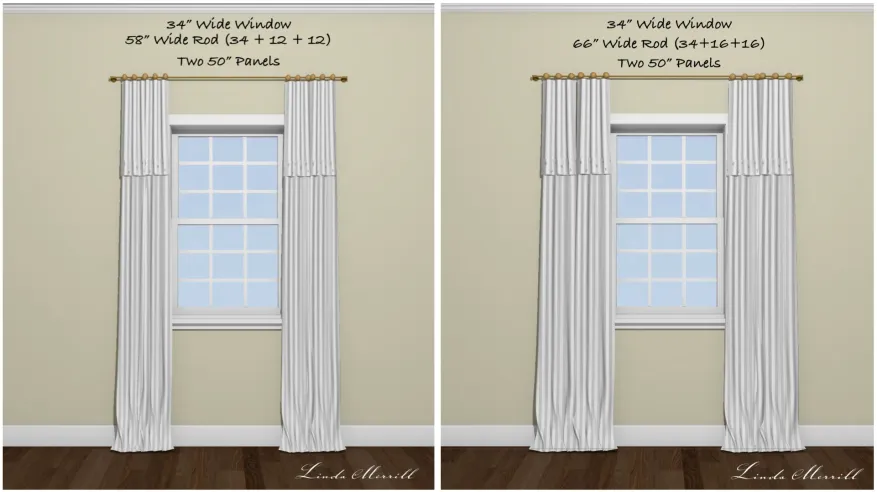
Measure the curtain rod or intended mounting span, not just the glass.
Step 2: Multiply by 2.5
Example:
- Rod width = 100 inches
- Required fabric width = 250 inches total
Step 3: Divide Into Panels
For two panels:
- Each panel ≈ 125 inches wide
Step 4: Account for Pleat Style
Certain pleats require additional fullness:
- Ripple fold: 2.0×–2.2×
- Pinch pleat: 2.3×–2.7×
- Goblet pleat: up to 3×
The 2.5× rule works as a reliable universal baseline.
Floor-to-Ceiling Placement: The Companion Rule
Width alone isn’t enough.
Professional designers mount curtain rods:
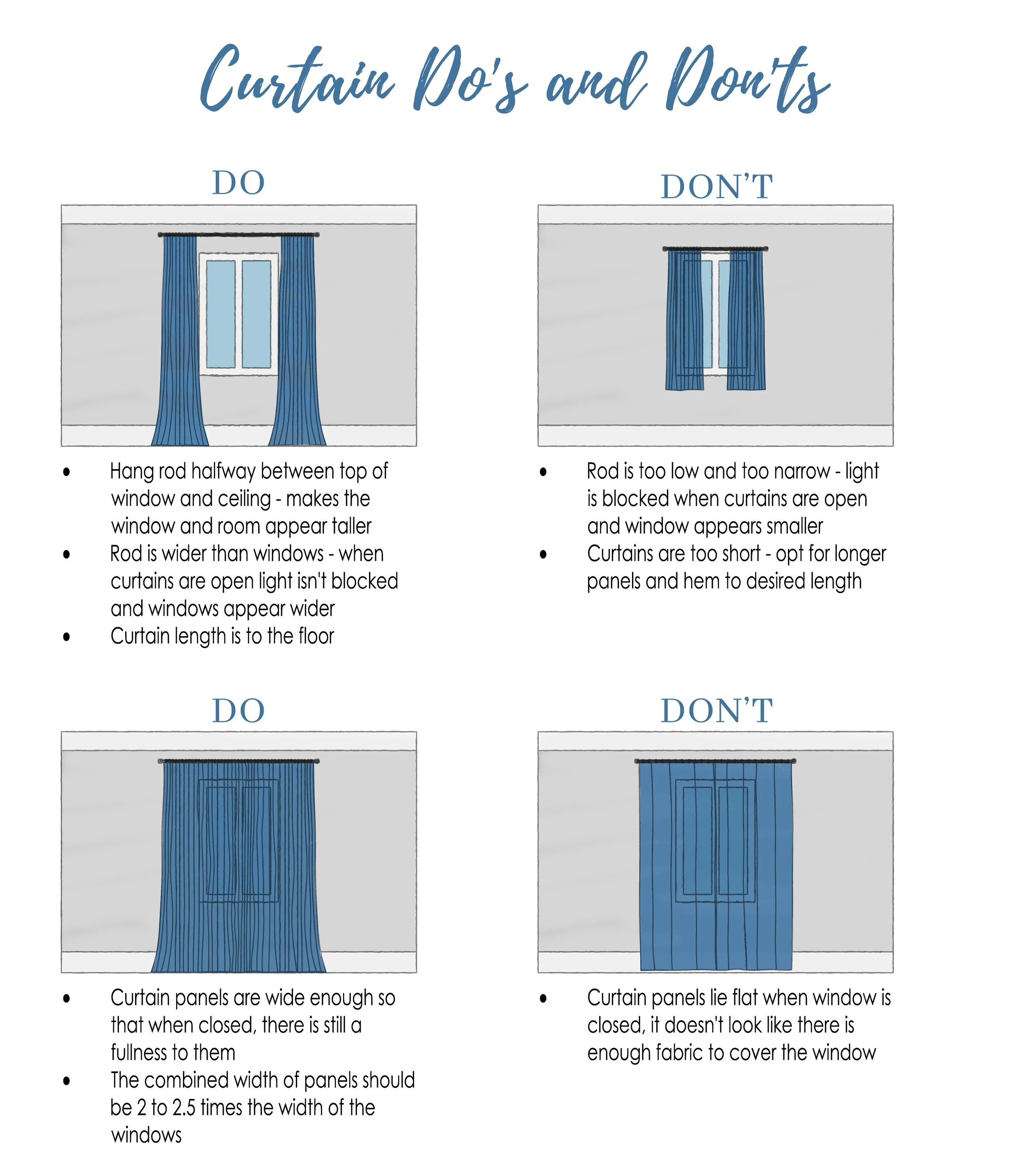
- Near the ceiling, not directly above windows
- Extending beyond window edges
This approach:
- Enhances vertical scale
- Maximizes daylight exposure
- Prevents visual crowding
Combined with 2.5× width, it creates hotel-level elegance.
Fabric Type and Fullness Adjustments
Different materials behave differently.
Sheer Curtains
Require more fullness (2.5×–3×) because light fabrics compress visually.
Linen Blends
Perform perfectly around 2.3×–2.5×.
Velvet or Heavy Drapery
May look best closer to 2×–2.3× due to thickness.
The lighter the fabric, the more width it needs.
The Role of Movement
Curtains are among the few interior elements that move naturally.
Airflow causes folds to shift subtly, adding life to a room.
Adequate width allows motion without distortion. Narrow curtains resist movement, appearing stiff and artificial.
This gentle motion contributes to feelings of relaxation and livability.
Acoustic Benefits of Proper Fullness
Extra fabric doesn’t only improve aesthetics.
More material absorbs sound waves, reducing echo and harsh acoustics.
Benefits include:
- Softer conversations
- Reduced outside noise
- Improved home office comfort
- Better media room acoustics
Thus, fullness contributes to sensory comfort beyond visuals.
Common Mistakes Homeowners Make
Buying Based on Window Size Alone
Ignoring fullness ratios leads to under-scaled curtains.
Prioritizing Cost Per Panel
Buying fewer panels saves money initially but reduces overall effect.
Mounting Too Narrow
Rods equal to window width compress visual space.
Ignoring Stack Width
Curtains need space to gather when open.
Avoiding these mistakes dramatically improves results.
Why Designers Rarely Break the 2.5× Rule
Interior designers adjust many design principles, but fullness ratios remain surprisingly consistent.
Why?
Because human perception of fabric proportion has remained stable across cultures and eras.
Whether modern minimalist or classic traditional, sufficient fullness always reads as intentional and refined.
Small Rooms Benefit the Most
Many people assume wide curtains suit only large homes.
In reality, small spaces gain the greatest improvement.
Wide curtains:
- Blur wall boundaries
- Increase perceived scale
- Add softness without clutter
- Replace decorative wall items
A compact apartment can feel significantly more spacious through correct curtain proportions alone.
Budget Strategy: Achieving the Look Without Overspending
You don’t necessarily need luxury fabrics.
Instead:
- Choose affordable fabric with higher width
- Prioritize measurement over brand names
- Use neutral tones for longevity
- Invest in proper installation
Proportion matters more than price.
The Emotional Impact of Proper Curtains
Design ultimately influences emotion.
Correctly proportioned curtains create:
- Calmness through visual rhythm
- Warmth through light diffusion
- Security through enclosure
- Sophistication through scale
These feelings arise subconsciously, which explains why professionally designed rooms feel instantly comfortable.
The Future of Curtain Design
Modern interiors increasingly emphasize softness to balance technology-heavy lifestyles.
As homes integrate smart lighting and minimal furniture, textiles play a larger role in humanizing spaces.
Expect trends toward:
- Wider installations
- Ceiling-mounted tracks
- Custom-fit solutions
- Layered sheer and blackout systems
The 2.5× principle remains foundational regardless of style evolution.
Final Thoughts: The Difference Is Proportion, Not Decoration
The biggest lesson in curtain design is surprisingly simple:
Beautiful interiors are rarely about buying better things — they’re about using correct proportions.
The reason designer spaces look effortless isn’t hidden luxury; it’s thoughtful geometry.
By choosing curtains approximately 2.5 times wider than your window, you allow fabric to behave naturally, light to soften gracefully, and architecture to feel intentional.
The transformation is immediate yet subtle.
No dramatic renovation. No expensive redesign.
Just enough fabric to let the room breathe.
And once you see the difference, flat, undersized curtains will never look right again.
Related Products