Curtain Fullness: Should You Choose 1.5x or 2x? A Visual, Practical Guide to Getting It Right

Feb 28 2026
When you’re ordering custom curtains, one detail quietly determines whether your room looks tailored and luxurious—or flat and unfinished:
Fullness ratio.
Should you choose 1.5x fullness or 2x fullness?
It sounds technical. It isn’t.
But it dramatically changes:
How your curtains hang
How deep the pleats look
How much light they block
How expensive your space feels
And how much fabric you pay for
This guide walks you through everything you need to know about curtain pleat ratios, side-by-side comparisons, room-by-room recommendations, budgeting considerations, and how to choose the right fullness for your exact space.
By the end, you’ll know exactly which ratio works best for your home—and why.
What Does Curtain “Fullness” Actually Mean?
Curtain fullness refers to the ratio between:
The finished width of your curtain panels
and
The width of your curtain rod or track
If your rod is 100 inches wide:
1.5x fullness = 150 inches of fabric total
2x fullness = 200 inches of fabric total
The more fabric used, the deeper and richer the folds appear when the curtains are closed.
Think of it like gathering fabric into waves.
More fabric = deeper waves.
Less fabric = flatter appearance.
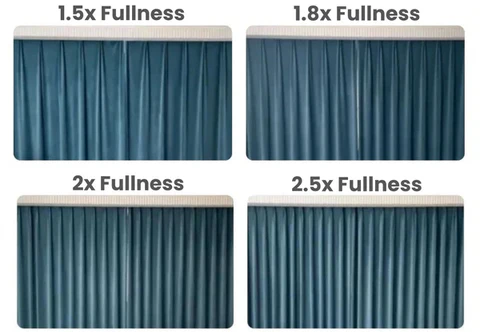
1.5x vs 2x Fullness: Quick Comparison
| Feature | 1.5x Fullness | 2x Fullness |
|---|---|---|
| Look | Light, modern | Rich, luxurious |
| Pleat depth | Shallow | Deep, dramatic |
| Fabric cost | Lower | Higher |
| Light blocking | Moderate | Better |
| Best for | Minimal interiors | Classic or formal rooms |
| Stack-back bulk | Smaller | Larger |
Now let’s break this down visually and practically.
Visualizing the Difference: What It Actually Looks Like
Since fullness affects folds, imagine standing in front of your window.
1.5x Fullness Look
Pleats appear softer and flatter
Fabric falls with gentle waves
Slight gaps between folds may show
Works well for casual spaces
It feels relaxed and modern.
2x Fullness Look
Folds are deeper and more sculpted
Fabric appears layered and thick
Window looks framed and intentional
Feels more tailored and high-end
It creates drama—even with simple fabric.
If you’ve ever admired hotel curtains at places like Four Seasons Hotel, you were likely looking at 2x fullness or more.
The Math Behind It (Without Overcomplicating It)
Here’s how to calculate:
Step 1: Measure Rod Width
Let’s say your rod is 120 inches wide.
Step 2: Multiply by Fullness Ratio
120 × 1.5 = 180 inches fabric needed
120 × 2 = 240 inches fabric needed
Divide this between two panels if using a pair.
So for 2x fullness on a 120" rod:
Two panels of 120 inches each
It’s straightforward—but impactful.
When 1.5x Fullness Makes Sense
Modern minimalist interiors
Sheer curtains
Narrow windows
Tight budgets
Layered with blinds or shades
If you love clean lines and understated style—often seen in homes inspired by brands like IKEA—1.5x fullness works beautifully.
It avoids overwhelming a streamlined space.
When 2x Fullness Is Worth It
Choose 2x fullness if:
You want a luxurious, designer look
You’re using heavy drapery fabrics
The window is large or tall
Light blocking matters
The curtains are a main focal point
Traditional interiors, transitional styles, and formal living rooms benefit most.
If your goal is visual richness, 2x is the safer bet.
Room-by-Room Recommendations
Living Room
Statement drapes → 2x
Casual linen panels → 1.5x
Large windows especially benefit from extra fullness.
Bedroom
If you want better light control and softness, go 2x.
Bedrooms feel more restful when curtains look plush and enveloping.
Dining Room
Formal dining areas almost always look better with 2x fullness.
Home Office
Minimalist or modern workspace?
1.5x keeps things crisp and uncluttered.
Fabric Type Changes the Equation
The heavier the fabric, the more fullness you can “get away with.”
Sheers
Sheers almost always need 2x fullness minimum.
Otherwise, they look sparse.
Linen
Linen looks relaxed even at 1.5x.
But 2x adds softness.
Velvet
Velvet already feels heavy.
2x creates dramatic folds.
1.5x can still look good if the window isn’t huge.
Light Control Differences
More fabric equals fewer gaps.
2x fullness:
Better privacy
Fewer light leaks
Fuller overlap in the center
If your goal is light blocking without blackout lining, 2x helps naturally.
Budget Considerations
Fabric is the largest cost driver in custom curtains.
Going from 1.5x to 2x increases fabric usage by 33%.
That’s significant for:
Large windows
Expensive textiles
Multiple rooms
If budget matters, you could:
Use 2x in main rooms
Use 1.5x in secondary spaces
Smart allocation preserves visual impact where it matters most.
Stack-Back Space: An Often-Ignored Factor
Stack-back is how much wall space curtains occupy when open.
2x fullness means:
Thicker stacked panels
More wall clearance needed
If you have limited wall space beside the window, 1.5x may function better.
Curtain Header Styles and Fullness
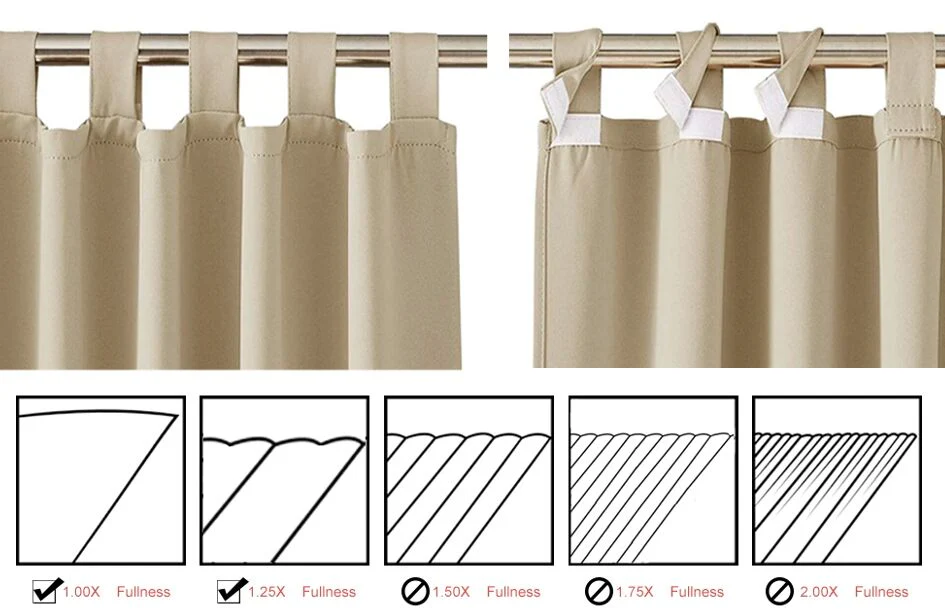
Different pleat styles require different fullness.
Grommet Curtains
Usually look best at 1.5x–1.8x.
Too much fullness can look bulky.
Pinch Pleat
Traditionally 2x or more.
Classic elegance demands depth.
Ripple Fold (Wave)
Often requires specific fullness ratios (around 2x) depending on track system.
This style, popular in modern interiors and seen frequently in hospitality projects designed by firms like Gensler, depends heavily on proper fullness to achieve uniform waves.
Ceiling Height Matters
Tall ceilings benefit from 2x fullness.
Why?
Because extra vertical space visually balances heavier folds.
Low ceilings?
1.5x can prevent visual heaviness.
The “Designer Rule”
If you’re unsure:
Small window → 1.5x works
Large window → 2x safer
Luxury goal → 2x
Budget priority → 1.5x
Interior designers often default to 2x because it rarely looks underwhelming.
Common Mistakes to Avoid
Choosing 1.5x for sheer panels (they’ll look thin)
Forgetting to measure rod width correctly
Ignoring stack-back clearance
Mixing fullness ratios in the same room
Underestimating how much fabric changes appearance
Does 2x Always Look Better?
Not always.
In ultra-modern homes with clean architectural lines, too much fullness can feel traditional.
If your style leans contemporary—think smooth surfaces, neutral palettes, minimal decor—1.5x often aligns better.
A Simple Decision Framework
Ask yourself:
Is the curtain decorative or functional?
Is the room formal or casual?
Do I want subtle or dramatic folds?
Is my window small or large?
Does my budget allow extra fabric?
If you answer:
Decorative + Formal + Dramatic → 2x
Functional + Casual + Minimal → 1.5x
Real-Life Scenario Example
Window width: 100 inches
Fabric: Medium-weight linen
Style: Modern living room
Option A – 1.5x
Total fabric: 150 inches
Look: Clean, slightly relaxed
Option B – 2x
Total fabric: 200 inches
Look: Fuller, more layered
If this is your primary entertaining space, 2x adds polish.
If it’s a secondary sitting area, 1.5x is sufficient.
Is 2x Worth the Extra Cost?
If curtains are a focal point in your room, yes.
If they’re secondary to architectural features or layered behind blinds, maybe not.
Think of fullness as the difference between:
A tailored jacket
and
A basic shirt
Both function.
Only one elevates.
Final Recommendation
If you want the safest choice that rarely disappoints:
Choose 2x fullness for main rooms.
If you prefer modern minimalism or want to control budget:
Choose 1.5x for casual or secondary spaces.
Curtain fullness may seem small—but it shapes how finished your room feels every single day.
Make the choice intentionally, and your windows will reward you with balance, softness, and architectural harmony.
Because in interior design, details aren’t just details.
They’re the difference between “fine” and “beautiful.”
Need Help with Your Custom Project?
Have questions about materials, sizing, or looking for a quick quote? Drop us a message and our experts will respond within 24 hours.
Chat on WhatsApp
+1 (304) 356-6765
Send us an Email
hello@incustom.com
Picked for You