The Business Value of Smart Irrigation Systems: A Triple Win for Water Savings, Cost Reduction, and Sustainability

Aug 19 2026
Water is one of the most valuable resources in any landscape, yet traditional irrigation systems often use far more water than plants actually need. For homeowners, property managers, commercial facilities, municipalities, hotels, resorts, golf courses, and agricultural operations, inefficient irrigation can quietly become a significant operating expense.
A sprinkler system may run on schedule every morning, but plants do not consume exactly the same amount of water every day. Weather changes. Temperatures fluctuate. Rainfall varies. Soil conditions differ from one area to another. Some plants need frequent irrigation, while others can thrive with much less water.
This is where smart irrigation systems are changing the way landscapes are managed.
Unlike conventional irrigation controllers that operate primarily according to fixed schedules, smart irrigation technology can use weather data, soil moisture information, flow monitoring, plant requirements, and real-time environmental conditions to determine when and how much water should be applied.
The result is more than simply a greener lawn.
A well-designed smart irrigation system can create a powerful business advantage by combining water conservation, lower operating costs, and environmental responsibility.
These three benefits reinforce one another. Saving water reduces utility expenses. Lower water consumption can reduce the environmental impact of a property. Better irrigation efficiency can also protect plants, reduce maintenance requirements, and improve the long-term performance of a landscape.
For businesses considering landscape improvements, smart irrigation should therefore be viewed not merely as a technology upgrade, but as a long-term investment in operational efficiency.
This article explores the business value of smart irrigation systems and explains how water savings, cost savings, and sustainability can work together to create a more efficient and financially responsible landscape.
What Is a Smart Irrigation System?
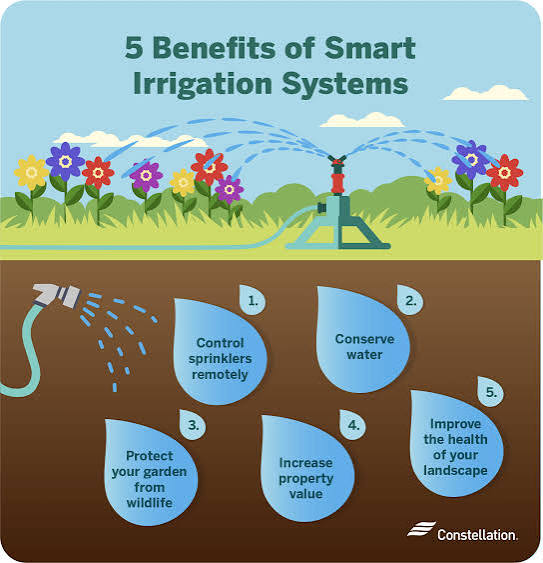
A smart irrigation system is an irrigation management system that uses technology to make watering decisions based on actual landscape conditions rather than relying exclusively on predetermined schedules.
A traditional irrigation controller might be programmed to water a property every Monday, Wednesday, and Friday for a certain number of minutes.
The problem is obvious.
What happens if it rains heavily on Tuesday?
The system may still operate on Wednesday.
What happens during an unusually cool week?
Plants may require less water, but the controller may continue using the same schedule.
What happens during an extremely hot period?
The programmed schedule may not provide enough water.
Smart irrigation systems are designed to respond to these changing conditions.
Depending on the system, smart irrigation technology may incorporate:
- Weather forecasts
- Local temperature data
- Rainfall information
- Evapotranspiration data
- Soil moisture sensors
- Flow meters
- Rain sensors
- Pressure monitoring
- Landscape zones
- Plant types
- Soil conditions
- Historical irrigation data
- Mobile monitoring and control
The system can then adjust watering frequency and duration according to actual demand.
This fundamental change—from watering according to a clock to watering according to conditions—is the foundation of smart irrigation.
Why Irrigation Efficiency Has Business Value
Water may appear to be a relatively small component of operating expenses compared with labor, rent, energy, equipment, or property maintenance.
However, irrigation costs can accumulate over time.
A large commercial property may contain extensive lawns, planting beds, trees, shrubs, and other landscaped areas. Maintaining these areas requires regular irrigation, particularly during dry or hot seasons.
If the system is inefficient, unnecessary water consumption can continue day after day.
The cost is not limited to the water bill.
Excessive irrigation can also create secondary costs, including:
- Plant disease
- Root problems
- Soil erosion
- Weed growth
- Water runoff
- Landscape replacement
- Drainage problems
- Increased maintenance
- Irrigation repairs
- Labor associated with manual adjustments
A smart irrigation strategy addresses these issues at the management level.
Instead of simply asking, "How often should we water?" property owners can begin asking a more valuable question:
"How much water does this landscape actually need?"
That shift can have significant financial implications.
The First Business Benefit: Saving Water
The most obvious advantage of smart irrigation is improved water efficiency.
Traditional systems frequently operate with a safety margin because managers want to avoid underwatering plants.
Unfortunately, that safety margin can become chronic overwatering.
Smart irrigation technology provides more precise control.
Instead of automatically applying the same amount of water regardless of conditions, the system can reduce irrigation when natural rainfall or cooler weather lowers plant water requirements.
During hotter or drier periods, it can increase irrigation when necessary.
This approach can significantly reduce unnecessary watering.
Weather-Based Irrigation
Weather-based irrigation controllers use environmental data to adjust watering schedules.
For example, if a weather service indicates that significant rainfall is expected, irrigation can be reduced or delayed.
After rainfall, the system can account for the additional moisture rather than continuing with a standard schedule.
This prevents one of the most common forms of irrigation waste: watering landscapes that have already received sufficient moisture.
Soil Moisture Monitoring
Soil moisture sensors provide another layer of intelligence.
Instead of estimating whether soil is sufficiently wet, the system can use sensor information to determine moisture conditions.
This is particularly useful for properties with varying soil types or irrigation zones.
For example, one planting bed may retain moisture longer than another.
A fixed irrigation schedule treats both areas similarly.
A smart system can respond differently.
Flow Monitoring
Water flow monitoring is especially valuable for commercial properties.
A damaged irrigation line, broken sprinkler head, or leaking valve can waste large quantities of water before anyone notices the problem.
Flow sensors can identify unusual water consumption patterns.
If the system detects a flow rate that is significantly different from normal operation, managers may receive an alert.
This turns irrigation management from a reactive process into a preventive one.
Water Savings Become Financial Savings
The relationship between water efficiency and financial performance is straightforward.
Less unnecessary water use = lower water consumption = lower operating costs.
However, the actual financial value can extend beyond the water bill.
Consider a commercial property with a large landscaped area.
If irrigation inefficiency causes thousands of gallons of water to be wasted regularly, the property is effectively paying for water that provides little or no landscape benefit.
Reducing that waste improves the property's operating efficiency.
For businesses with multiple locations, the impact can become even more significant.
A small reduction in irrigation consumption at one property may appear modest.
But when the same improvement is applied across ten, twenty, or one hundred properties, the aggregate savings can become substantial.
This is one reason smart irrigation is particularly attractive for organizations with large portfolios.
Reducing Labor Costs
Smart irrigation systems can also reduce the amount of manual irrigation management required.
Traditional systems often require staff to:
- Inspect controllers
- Adjust watering schedules
- Check weather conditions
- Inspect sprinkler zones
- Identify leaks
- Modify seasonal settings
- Respond to irrigation complaints
- Investigate unusual water bills
Smart systems can automate many of these tasks.
Remote monitoring allows managers to review system performance without physically visiting every irrigation controller.
Mobile applications can make it possible to change settings, receive alerts, and review irrigation activity remotely.
For property management companies, this can reduce unnecessary site visits.
For landscaping companies, centralized monitoring can make it easier to manage multiple customer properties.
For large commercial facilities, automation can free maintenance personnel to focus on higher-priority tasks.
Protecting Plants Through Better Irrigation
Saving water should not mean allowing landscapes to become unhealthy.
In fact, one of the strongest arguments for smart irrigation is that precision watering can improve plant health.
Overwatering can be just as damaging as underwatering.
Too much moisture may contribute to:
- Root disease
- Fungal problems
- Poor root development
- Nutrient leaching
- Weak plant growth
- Soil compaction
- Weed problems
Underwatering, on the other hand, can cause:
- Wilting
- Leaf damage
- Reduced growth
- Tree stress
- Plant loss
- Brown lawns
Smart irrigation aims to find the appropriate balance.
The goal is not simply to use less water.
The goal is to use the right amount of water at the right time in the right location.
That distinction is critical.
The Environmental Value of Smart Irrigation
Water conservation is not only a financial issue.
It is also an environmental responsibility.
Fresh water is a limited resource, and many regions experience periodic or long-term water shortages.
Reducing unnecessary irrigation can help decrease pressure on local water supplies.
But the environmental benefits extend further.
Efficient irrigation can reduce runoff.
When irrigation applies water faster than soil can absorb it, excess water can flow into drains and waterways.
That runoff may carry:
- Fertilizers
- Pesticides
- Soil particles
- Organic debris
- Other pollutants
Efficient irrigation reduces the likelihood of excessive runoff by applying water more carefully.
This can contribute to healthier surrounding ecosystems.
Supporting Corporate Sustainability Goals
For businesses, environmental performance increasingly influences reputation, property management strategies, investment decisions, and customer expectations.
A company that actively reduces water consumption can demonstrate a practical commitment to sustainability.
Smart irrigation can support broader sustainability initiatives involving:
- Water conservation
- Resource efficiency
- Green building
- Landscape sustainability
- Environmental management
- Operational efficiency
Unlike some sustainability initiatives that may be difficult for customers to see, efficient landscape irrigation is relatively tangible.
Visitors can see healthy landscaping while the organization simultaneously reduces unnecessary resource consumption.
That creates an attractive combination:
Better landscape performance with lower resource use.
Smart Irrigation and Return on Investment
Any technology investment should ultimately answer one question:
Does the investment create enough value to justify the cost?
Smart irrigation systems require an initial investment.
Depending on the property, this may include:
- Smart controllers
- Sensors
- Flow meters
- Weather data services
- New valves
- Wiring
- Communication equipment
- Installation
- Programming
- System testing
- Ongoing maintenance
The return comes from multiple sources.
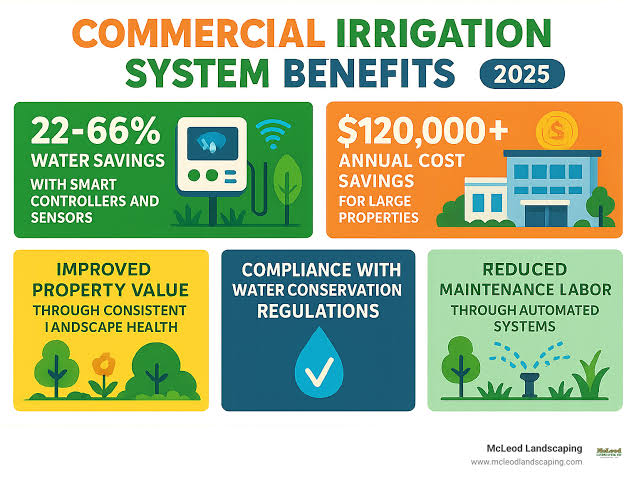
The most obvious is reduced water consumption.
But the total economic benefit may also include:
- Lower irrigation labor
- Fewer emergency repairs
- Reduced plant replacement
- Better landscape health
- Lower runoff-related problems
- Improved maintenance efficiency
- Remote management
- Better visibility into water usage
Therefore, calculating return on investment should not focus exclusively on the water bill.
A comprehensive analysis should consider the total lifecycle cost of irrigation management.
A Simple Way to Think About Irrigation ROI
Property owners can evaluate a smart irrigation investment using several categories.
Initial Investment
Calculate the cost of equipment, installation, programming, and commissioning.
Annual Water Savings
Estimate how much water consumption can realistically be reduced.
Annual Labor Savings
Estimate how much manual inspection and adjustment time can be eliminated.
Maintenance Savings
Consider whether better irrigation control can reduce leaks, plant replacement, and irrigation-related repairs.
Long-Term Value
Consider the value of improved landscape quality, resource efficiency, and environmental performance.
The actual payback period will vary significantly depending on property size, climate, water rates, landscape design, existing irrigation efficiency, and system complexity.
Large properties with high irrigation demand may have particularly strong opportunities for savings.
Why Landscape Design Still Matters
Smart irrigation technology is powerful, but technology cannot completely compensate for poor landscape planning.
A poorly designed landscape may require excessive water regardless of how intelligent the controller is.
For example, installing water-intensive plants throughout a large sunny area creates a fundamentally high irrigation demand.
A smart controller can optimize that demand, but it cannot make thirsty plants behave like drought-tolerant species.
This is why smart irrigation should be integrated with water-efficient landscape design.
A comprehensive strategy may include:
- Appropriate plant selection
- Hydrozone planning
- Efficient irrigation components
- Proper soil preparation
- Mulching
- Appropriate grading
- Drip irrigation where suitable
- Efficient sprinkler technology
- Smart controls
- Regular maintenance
Technology works best when the entire landscape system is designed efficiently.
The Importance of Hydrozone Design
Hydrozoning means grouping plants with similar water requirements into the same irrigation zones.
For example, drought-tolerant shrubs should not necessarily share the same irrigation zone as high-water-demand lawn areas.
Without hydrozoning, the controller has limited ability to optimize irrigation.
One area may receive too much water while another receives too little.
With appropriate zoning, smart irrigation controls can manage different landscape areas according to their actual needs.
This improves both water efficiency and plant health.
Smart Irrigation and Drip Irrigation
Drip irrigation and smart controllers can work particularly well together.
Drip irrigation delivers water slowly and directly to the root zone of plants.
This can reduce evaporation and runoff compared with inefficient surface watering.
However, drip systems still require proper design and maintenance.
Emitters can become clogged. Lines can leak. Pressure can vary.
Adding smart monitoring can improve visibility and control.
The combination of efficient water delivery and intelligent scheduling can create a highly efficient irrigation strategy.
Remote Irrigation Management
One of the most valuable features of modern smart irrigation is remote access.
Property managers do not necessarily need to be physically present at the controller to make adjustments.
Through a connected system, managers may be able to:
- Change irrigation schedules
- Review system activity
- Receive alerts
- Monitor flow
- Adjust zones
- Respond to weather conditions
- Identify potential problems
This is especially valuable for properties with large landscapes or multiple locations.
Imagine a company managing fifty commercial properties.
Without centralized technology, irrigation management can become highly labor-intensive.
With smart controls and remote access, many routine tasks can be handled more efficiently.
Data Turns Irrigation Into a Management System
Traditional irrigation often operates as a hidden utility.
Water is consumed, but managers may have limited visibility into exactly how and when it is being used.
Smart irrigation changes this.
Data can provide information about:
- Water consumption
- Irrigation frequency
- Zone performance
- Flow rates
- Weather conditions
- System alerts
- Historical trends
This information can help managers make better decisions.
Instead of asking why the water bill increased, managers can investigate irrigation data and identify potential causes.
This is a major shift from reactive maintenance to data-informed management.
Identifying Leaks Before They Become Expensive
Leaks are among the most damaging problems in irrigation systems because they can continue unnoticed.
A small leak may appear insignificant.
But over weeks or months, the wasted water can become substantial.
A larger line break can produce an even more dramatic increase in consumption.
Smart flow monitoring can help identify unusual patterns.
For example, if a zone normally uses a certain amount of water but suddenly consumes significantly more, the system can flag the change.
Early detection can prevent both water waste and expensive landscape damage.
Smart Irrigation for Commercial Properties
Commercial properties are particularly strong candidates for smart irrigation.
Potential applications include:
- Office parks
- Apartment communities
- Hotels
- Resorts
- Shopping centers
- Hospitals
- Schools
- Industrial campuses
- Corporate headquarters
- Public parks
- Municipal landscapes
These properties often contain large landscaped areas and multiple irrigation zones.
The larger and more complex the landscape, the more difficult manual irrigation management becomes.
Smart technology provides a way to manage that complexity.
Smart Irrigation for Hotels and Resorts
Hotels and resorts have a unique challenge.
Landscaping contributes directly to the guest experience.
Beautiful lawns, gardens, trees, and planting beds help create a premium atmosphere.
At the same time, these properties may have substantial water consumption.
Smart irrigation allows hospitality businesses to maintain attractive landscapes while controlling water use.
This can support both operational efficiency and environmental positioning.
For properties marketing themselves around sustainability, efficient irrigation can also become part of a broader green hospitality strategy.
Smart Irrigation for Property Managers
Property managers often manage landscapes they do not personally inspect every day.
A smart irrigation platform can provide greater visibility.
Instead of relying entirely on landscaping contractors or maintenance staff to report problems, managers can receive system information directly.
This creates better accountability.
If water consumption suddenly increases, management can investigate.
If irrigation is operating during unexpected weather conditions, settings can be reviewed.
If a zone experiences abnormal flow, maintenance can be scheduled.
The result is better control over an important operating expense.
The Role of Maintenance
Even the smartest irrigation system requires maintenance.
Technology does not eliminate physical problems.
Sprinkler heads can still become damaged.
Valves can fail.
Pipes can leak.
Sensors can malfunction.
Plants can grow and change the landscape.
Therefore, smart irrigation should be treated as part of a maintenance program rather than a replacement for maintenance.
Regular inspections should include:
- Sprinkler performance
- Valve operation
- Sensor accuracy
- Flow rates
- Controller settings
- Irrigation coverage
- Pressure
- Leaks
- Plant health
- Soil conditions
The best results come from combining automation with professional oversight.
Avoiding the "Set It and Forget It" Problem
One misconception about smart irrigation is that installation eliminates the need for human involvement.
It does not.
A smart controller can make decisions based on programmed rules and available data, but landscapes are dynamic.
Trees grow.
Plants change.
Irrigation zones may be modified.
Construction can alter drainage.
Weather patterns can change.
Property use can change.
The system should therefore be reviewed periodically.
Smart technology should reduce unnecessary work, not eliminate responsible management.
How to Evaluate a Smart Irrigation System
Before investing, property owners should evaluate more than the controller itself.
Ask several questions.
Does the system support weather-based adjustment?
This can improve irrigation responsiveness.
Can it monitor flow?
Flow monitoring can help detect leaks and abnormal usage.
Does it support multiple zones?
Large landscapes need flexible control.
Can it be managed remotely?
Remote access can reduce labor and improve response time.
Does it provide useful data?
A system that generates actionable information is more valuable than one that simply offers a smartphone interface.
Is it compatible with the existing irrigation infrastructure?
Compatibility can significantly affect installation costs.
Can the system be expanded?
Future landscape changes may require additional zones or sensors.
Is professional installation available?
Correct setup is essential to performance.
The Importance of Correct Installation
A smart irrigation controller cannot compensate for poorly installed irrigation infrastructure.
If sprinkler heads are incorrectly positioned, pressure is inconsistent, or zones are improperly configured, water efficiency will suffer.
Installation should therefore include a complete system assessment.
Professionals should evaluate:
- Existing irrigation equipment
- Water pressure
- Flow rate
- Pipe layout
- Sprinkler coverage
- Soil conditions
- Plant requirements
- Drainage
- Sun exposure
- Irrigation zones
The smart controller should be configured based on the actual landscape rather than simply using generic settings.
The Three-Part Business Case
The value of smart irrigation can ultimately be summarized through three interconnected benefits.
1. Water Savings
The system reduces unnecessary irrigation by responding to actual conditions.
2. Cost Savings
Lower water use, reduced labor, fewer irrigation failures, and healthier plants can reduce operating expenses.
3. Environmental Benefits
Reduced water consumption and runoff can contribute to more sustainable landscape management.
These benefits reinforce one another.
Saving water saves money.
Saving money makes sustainability more economically attractive.
Sustainable resource management strengthens long-term business resilience.
That is why smart irrigation should not be considered merely a landscaping accessory.
It is an operational management tool.
Looking Beyond the Initial Price
Businesses sometimes reject smart irrigation because the upfront cost is higher than that of a basic controller.
This comparison can be misleading.
A basic controller may be cheaper to purchase, but purchase price is only one part of the total cost.
The more useful question is:
How much will the system cost to own and operate over its useful life?
A low-cost controller that consistently overwaters a large landscape may ultimately be more expensive than a smarter system that costs more initially but reduces operating expenses.
This is the difference between evaluating purchase price and evaluating lifecycle value.
Smart Irrigation as a Long-Term Investment
A landscape is not a short-term asset.
Trees, shrubs, lawns, irrigation infrastructure, hardscape, and planting systems can remain in place for many years.
Irrigation decisions should therefore be evaluated over a similarly long period.
A smart irrigation system can evolve with the landscape.
New sensors can be added.
Zones can be adjusted.
Schedules can be refined.
Data can be reviewed.
Management practices can improve.
Over time, the system can become increasingly valuable as property managers understand the landscape's actual water requirements.
The Future of Landscape Water Management
Smart irrigation technology is part of a broader movement toward data-driven property management.
As sensors become more capable and connected systems become more accessible, irrigation management will likely become increasingly precise.
Future systems may integrate more closely with:
- Weather forecasting
- Soil monitoring
- Building management platforms
- Water utility data
- Landscape management software
- Predictive analytics
- Automated leak detection
- Remote maintenance systems
The ultimate goal is simple:
Use as little water as possible while maintaining the desired landscape performance.
That is a much more sophisticated goal than simply programming a sprinkler to run for thirty minutes every morning.
Conclusion
Smart irrigation systems represent an important shift in the way landscapes are designed, maintained, and managed.
Instead of relying on fixed schedules and assumptions, smart irrigation uses data and environmental conditions to make watering more precise.
For businesses and property owners, the value comes from three interconnected advantages.
First, smart irrigation saves water.
By reducing unnecessary watering and responding to rainfall, soil conditions, and weather, the system can improve irrigation efficiency.
Second, it saves money.
Lower water consumption can reduce utility expenses, while remote management, leak detection, and healthier landscapes can help control labor and maintenance costs.
Third, it supports environmental sustainability.
Using water more responsibly reduces pressure on valuable water resources and can help limit unnecessary runoff.
The most successful strategy is not simply installing a smart controller.
It is creating an integrated water-management system that combines efficient landscape design, appropriate plant selection, hydrozoning, efficient irrigation equipment, smart controls, monitoring, and professional maintenance.
When these elements work together, smart irrigation becomes much more than a piece of technology.
It becomes a practical business strategy for creating landscapes that are more efficient, more economical, and more environmentally responsible.
For commercial properties, large residential landscapes, hotels, resorts, property management portfolios, and other water-intensive landscapes, that combination can deliver value year after year.
In a world where water efficiency and operating costs are becoming increasingly important, the question is no longer simply whether a landscape needs irrigation.
The better question is:
Why continue watering blindly when technology can help you water smarter?
Welcome to leave a comment or message us for a customized quote and pricing inquiry.
Need Help with Your Custom Project?
Have questions about materials, sizing, or looking for a quick quote? Drop us a message and our experts will respond within 24 hours.
Chat on WhatsApp
+1 (304) 356-6765
Send us an Email
hello@incustom.com
Picked for You